
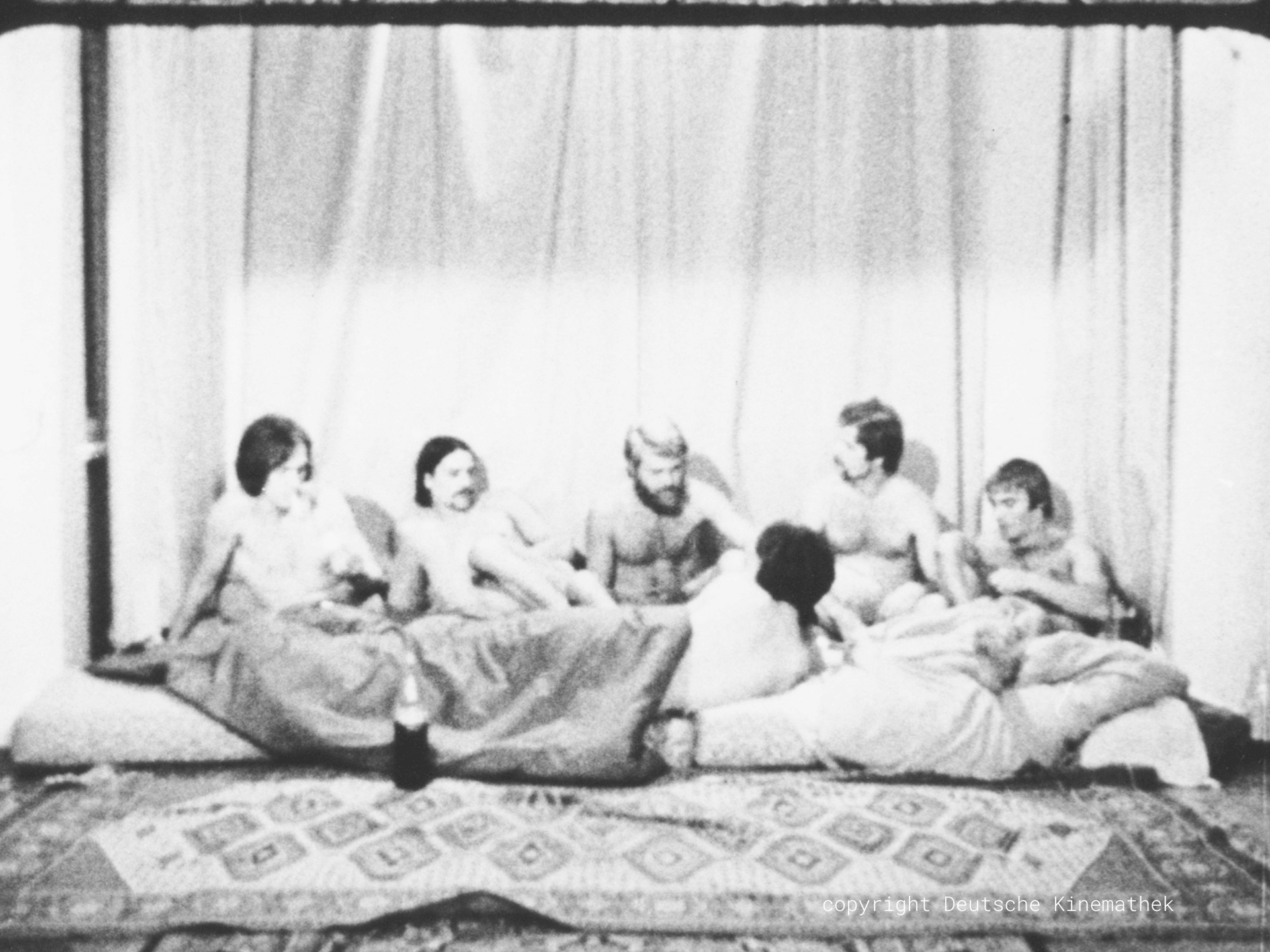
Berlin is easy to praise as a queer city. Rainbow flags on Schoeneberg lampposts, Berlinale sidebars, a dozen queer film nights a month. What is harder to see is the work underneath. The archives that preserved footage no one else would touch. The distributors who imported films the majors called too risky. The cinema operators who kept programming when funding disappeared. Inventing Queer Cinema Berlin, the opening exhibition of the Deutsche Kinemathek at its new home in E-Werk, is a rare chance to see that infrastructure made visible.
The exhibition does not just celebrate queer films. It maps the ecosystems that made them possible: archives, distributors, festivals and communities that fought for images of queer life to exist in public at all.
Queer cinema is not a niche, it is a way of looking
With Inventing Queer Cinema, the Deutsche Kinemathek opens its new home with a clear statement: queer cinema is not a niche, it is a way of looking at the world. The show traces filmmakers, festival directors, cinema operators and distributors who have shaped and reshaped queer cinema in Germany, and especially in Berlin, from the 1970s to today.
The focus is not only on iconic films and faces, but on the work around them. Film and photo installations, posters, documents and archival material show how queer lives made their way onto the screen and into cinemas. Larger holdings from the archive of Salzgeber, the queer distributor that has been bringing so-called too-risky films into German cinemas for decades, form one of the show's most substantial sections.
A short prologue with material from the 1910s points to a time when desiring bodies were already visible on film, long before there was shared language or legal protection for them.
Berlin as hub and projection surface
Geographically, the centre is clear. Berlin appears as a node in a much larger queer film network, but also as a city where those images are directly tied to lived reality. Names like Rosa von Praunheim, Monika Treut, Wieland Speck, and the circles around the Berlinale mark moments when formal experimentation collided with political struggle. Campaigns against Paragraph 175. Debates around HIV. Trans rights. New family models. None of these fights were separate from what was on screen. They shaped what could be filmed, funded, shown.
At the same time, the Kinemathek insists on looking outwards. International films and film workers make it clear that queer cinema only exists because of exchange, subtitles, guest programmes and festivals that cross borders. The exhibition ends up telling a story about resistance, solidarity and invention that runs straight into the present of streaming platforms, moderation rules and algorithmic censorship, without turning that into a dry media-studies lecture.
A studio cinema so queer film stays on a big screen
Inventing Queer Cinema is not just vitrines and wall texts. A small studio cinema connected to the exhibition runs a film series throughout the show's duration, bringing classics and newer work back onto a big screen. Queer film history becomes something the body experiences again: in glances, textures, soundtracks and the tension of a collective viewing situation.
The choice matters. Streaming has made queer films technically available in ways unimaginable thirty years ago, but it has also stripped them of the room. A queer film watched alone on a laptop is a different object from a queer film watched with a hundred other people in the dark. The studio cinema restores what the archive alone cannot.
Which images are still missing
An accompanying events programme, curated among others by Toby Ashraf, opens up conversations about what comes next. Which images are still missing. Who decides what is preserved. How visibility can be defended when funding, festivals and platforms are under pressure.
These are not academic questions. They are the same questions that run through every queer, kink and sex-positive space in Berlin right now. Which parties can still find venues. Which flyers still get through Instagram. Which images of pleasure can still be shared without being flagged. The exhibition names the film-history version of a fight the city knows well from other rooms.
Why this matters for the Berlin Kink Calendar community
For the communities the Berlin Kink Calendar speaks to, this exhibition is not a neutral education offer. It is a rare chance to see the infrastructure behind the obvious fact that you can simply go to a queer film night in Berlin: the labour, the risk and the care that sit behind every frame of a body that loves, fucks or exists against the norm.
The same logic applies to nightlife, to sex-positive spaces, to kink communities. None of it is obvious. All of it was invented, defended, rebuilt, sometimes lost, sometimes recovered. Inventing Queer Cinema Berlin is worth visiting not only because the material is strong, but because it makes the invention visible. It reminds the visitor that queer visibility has never been a given. Someone always had to make it, and someone always has to keep making it.
Before you mark your calendar: always double-check dates, location, and ticket info directly with the organizers.
Even the best promises come with fine print.