
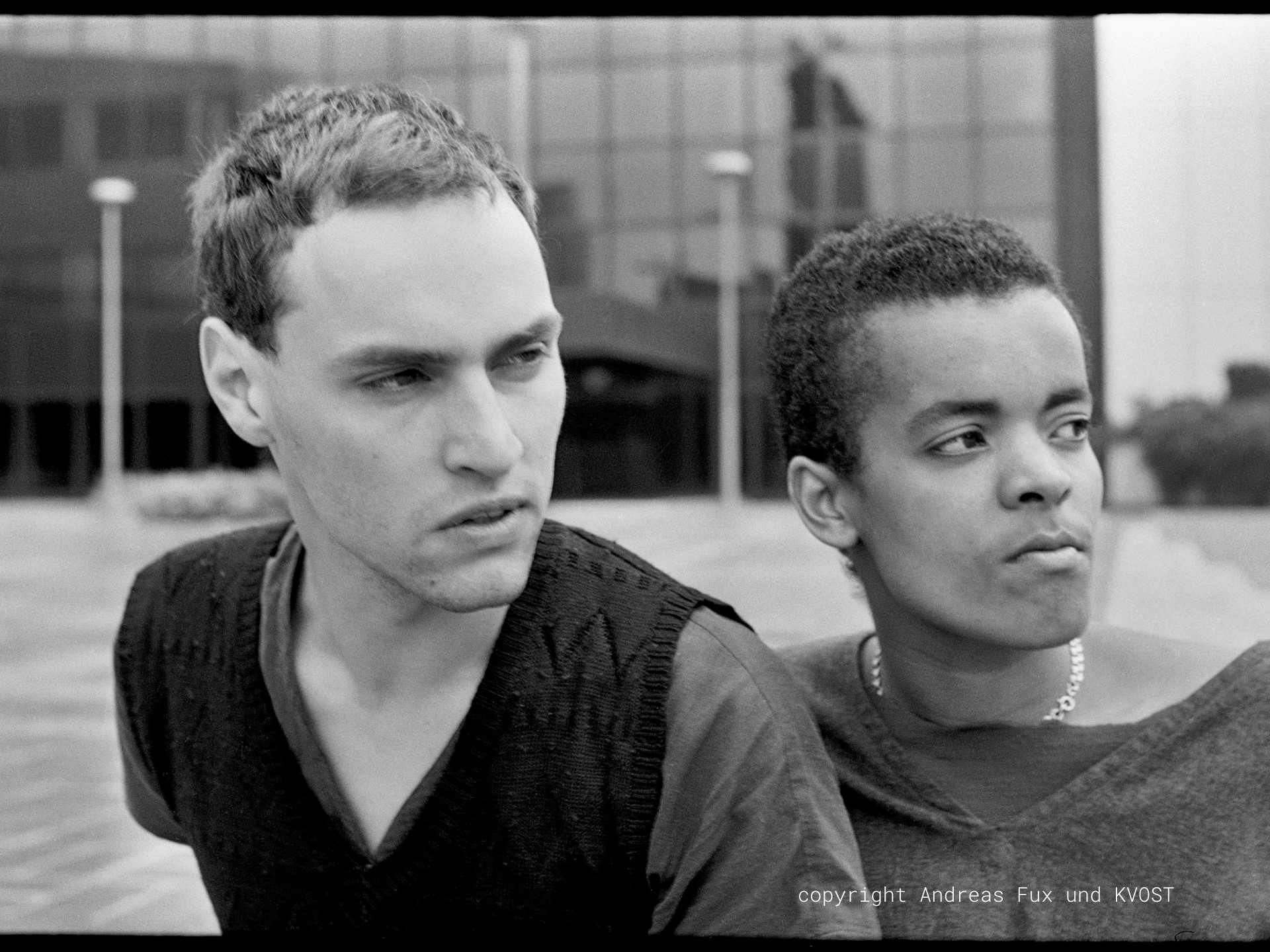
From 28 March to 28 June 2026
What the State Couldn’t Erase: Queer Art in the GDR (DDR)
Nine biographies between underground and propaganda and the question they were never allowed to ask out loud.
There’s a particular kind of silence that art learns to speak in when speaking is dangerous. Not absence, something closer to the opposite. A precision of form. A coded insistence. A body on canvas that carries more weight than the official caption would suggest.
The Double Life Was the Work
Toni Ebel, Andreas Fux, Harry Hachmeister, Jochen Hass, Dorothea von Philipsborn, Erika Stürmer-Alex, Rita “Tommy” Thomas, Jürgen Wittdorf, Egon Wrobel. Nine artists. Nine biographies shaped by a state that surveilled not just political dissent but desire itself.
Curated by Stephan Koal across four Berlin institutions, the exhibition gathers paintings, sculptures, ceramics, and photographs produced under conditions where sexual orientation was never simply private. It was a social fact the state could use against you. Affecting exhibition opportunities, professional advancement, access to international contacts. Shaping what you could paint, how explicitly, for whom.
The tension between what these artists knew about themselves and what the official culture would allow them to be didn’t remain outside the studio. It became the material. Wittdorf’s male nudes, Hachmeister’s staged self-portraits, Toni Ebel’s quiet domestic interiors. Read in this light, the work doesn’t get smaller. It opens.
Decriminalized, Not Free
The legal history is complicated in ways that expose how inadequate law is as a measure of freedom. The GDR decriminalized homosexuality between consenting adults in 1968 before West Germany did in 1994 (only decades later, in the treaty organizing the reunification), a fact sometimes invoked to argue for relative progressiveness.
That reading misses everything that happened below the level of criminal law. The social stigma. The institutional barriers. The SED’s deep suspicion of non-normative sexuality as politically destabilizing. The Stasi’s interest in queer individuals as potential points of leverage, documented in MfS operative files and in the surveillance of groups like the HIB (Homosexuelle Interessengemeinschaft Berlin).
Decriminalized, not free. The gap between those two conditions is where these nine artists lived and worked.
The Second Erasure
When the Wall fell, the expectation was that queer artists in the GDR would finally gain visibility. What happened instead was more complex and less just. DDR artists struggled to find footing in the reunified art market and its established hierarchies. For queer DDR artists, the problem compounded. They existed in a category nobody had the framework for. Too East for the Western queer art history being written. Too queer for the GDR retrospectives being mounted.
The result was a near-disappearance. Not dramatic erasure. Just the slow drift out of the record. The accompanying publication from DISTANZ Verlag is part of pulling them back in.
The Body as Political Territory
The mechanisms of state control over sexuality are not a historical curiosity. The specific forms change; the underlying logic that populations can be managed, in part, through the regulation of their bodies and desires, does not. Wilhelm Reich identified it in the 1930s. Foucault mapped it across centuries. These nine artists lived it in a specific place and time and made work from inside it.
That work is worth seeing now not as testimony to a closed chapter but as evidence of something ongoing. The body has always been political territory. What gets called deviant or destabilizing by any given power structure tells you exactly what that structure needs to suppress in order to sustain itself.
Queerness, in the GDR as elsewhere, didn’t wait for permission. It found its form.
“Queere Kunst in der DDR? Biografien zwischen Underground und Propaganda”, curated by Stephan Koal, runs 28 March – 28 June 2026 across KVOST, nGbK, Mitte Museum, and Werkbundarchiv – Museum der Dinge. A companion volume is published by DISTANZ Verlag.
Before you mark your calendar: always double-check dates, location, and ticket info directly with the organizers.
Even the best promises come with fine print.