
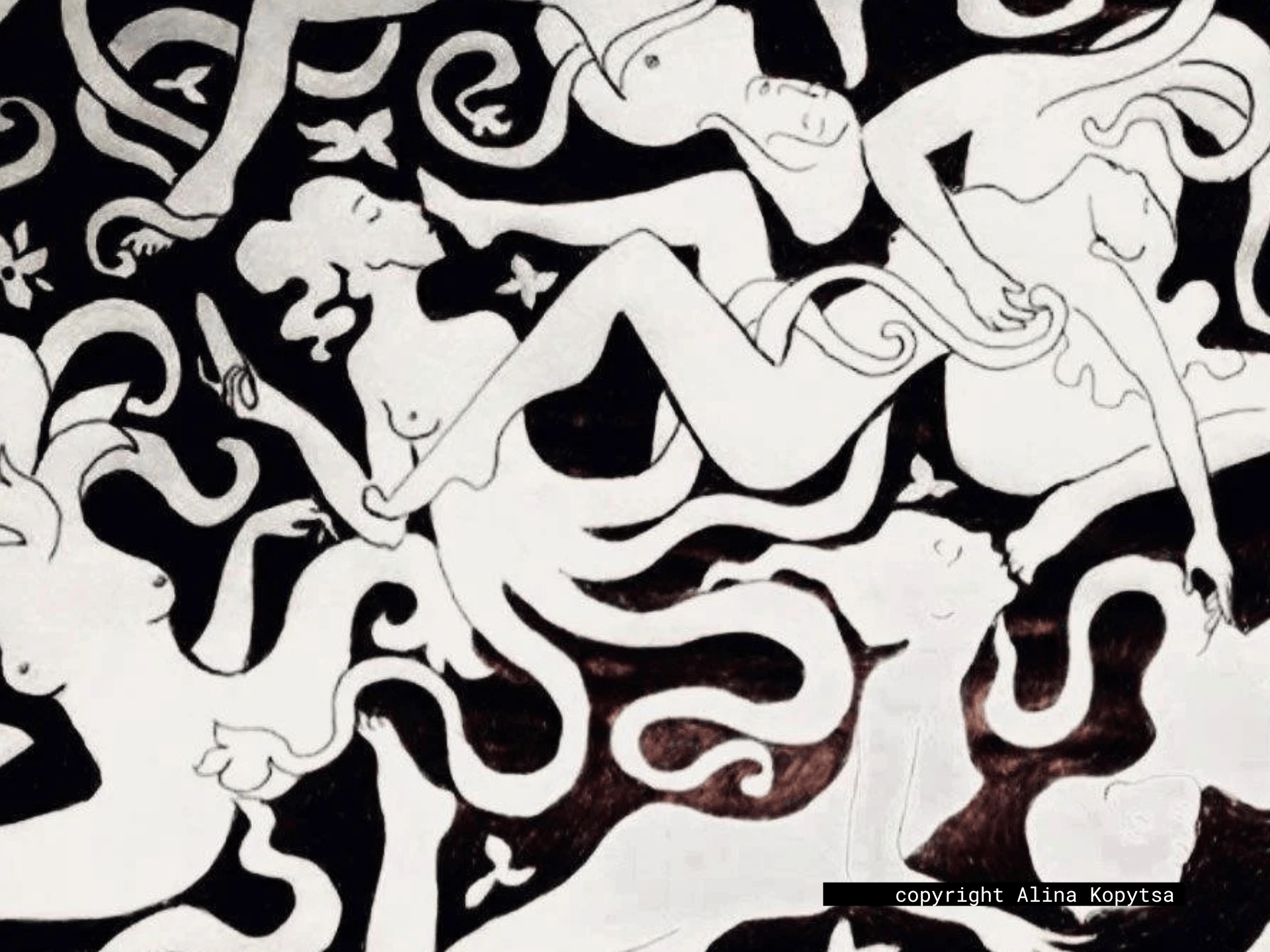
(AN)OTHER ORGY FLINTA edition is a deliberately slow-built orgy: more somatic research space than porn scene, with a clear FLINTA* frame and a lot of attention paid to the nervous system.
Most people have had the fantasy: a room full of desirable bodies, hands everywhere, losing yourself in a wave of touch. Anyone who has actually been in a group sex setting knows how quickly the fantasy collides with reality: different speeds, mixed expectations, sudden doubts, too much or too little sensation all at once.
(AN)OTHER ORGY FLINTA edition by luhmen d'arc takes that chaos seriously. It treats the orgy not as a performance to live up to, but as a collective experiment in intimacy with many, built slowly from the ground up.
A FLINTA-only frame
This edition is explicitly for people who identify as women, lesbians, non-binary, inter, trans or agender. In other words: everyone who is not endo cis male.
All constellations of bodies and chromosomes are welcome. Only cis men (those born, socialised and identifying as men) are asked to join other luhmen d'arc events instead.
You can attend alone, as a couple or as a polycule. The premise is that everyone is there both for their own experience and for the shared field, not to get something from specific others.
How the evening is built
Before anyone even considers orgy dynamics, there is a long preparatory phase. The facilitators draw from contact improvisation, consent practices, bodywork, nervous-system regulation and communication exercises to build presence and awareness.
You practice feeling your own body and limits, naming boundaries, needs and desires out loud, reading others' signals and the room as a whole, and breathing deeply enough to stay in contact with yourself when things get intense.
The guiding question is: how does a shared experience emerge, a big whole, instead of a noisy cluster of unrelated scenes? How do you contribute to a collective symphony rather than playing your solo over the top?
Orgy as re-staging of fantasies
From there, the group moves into an open free-flow phase: the orgy attempt itself. Between rounds there is time to pause, regulate, talk and gather resources before stepping back in.
Participants are invited to bring their own favourite images of orgy culture and see what happens when they are re-staged together. Decadent antique bacchanals with languid, lounging bodies. Teenage-memory pillow fights and spin-the-bottle chaos. Wild, overgrown tangles of plants and creatures. Sporty, porno-swinger energy. Hippie Summer-of-Love pile-ups. Slow drifting like a swarm in the sea, rather than pushing things to happen.
The understanding of orgy is deliberately wide. It can be explicit sex, but just as easily a sound orgy with a moaning choir, a sensual orgy of many hands, a BDSM biting circle, cuddle piles or even a sleep orgy.
Consent codes, pauses and roles
Throughout the night, the room runs on both verbal and non-verbal consent codes. Together you define signals for more, less, stop and I am not available, so people do not have to constantly talk over the intensity of the moment.
There are cosy timeout corners where you can stay in the room but out of interaction. Places where you will be left alone unless you signal otherwise.
Safer sex materials are provided, and the facilitators stay in a dedicated holding role, not as participants. They keep an eye on the room, offer gloves, lube and support as needed.
The aim is a space where generosity does not turn into people-pleasing, and courage does not override gut feelings. Participants are encouraged to respect both others' limits and their own.
Learning across orgies
The event treats each orgy not as a one-off, but as part of an ongoing series of experiments. Between rounds there is time to reflect: what worked for you, what overwhelmed you, what felt unexpectedly nourishing or boring?
The group looks at questions like: what makes you blossom almost by accident, without pushing? How do your nervous-system patterns show up when many people are involved? When does collective feel like support, and when like pressure?
By naming these dynamics together, people can return to the next edition with more vocabulary, more resources and less shame around both desire and reluctance.
Accessibility, inclusion and boundaries
The workshop space at IKSK is wheelchair-accessible. Its showers and toilets involve some steps, while the wider Holzmarkt area offers accessible facilities.
Languages are German and English, with translation and group formation adjusted so that everyone can communicate in a language they are comfortable with.
Identity categories such as gender, orientation, kink preferences, age, migration background and disability status are not used as selection criteria for participation. The focus is on behaviour: attentiveness, willingness to learn, capacity to collaborate across differences.
The workshop must be attended sober. Hate speech is not tolerated, and the team reserves the right to ask participants whose behaviour harms others to leave. Fees are refunded in that case, but no further claims are possible.
Why it belongs on the Berlin Kink Calendar
The Berlin Kink Calendar maps not only parties and dungeons, but also the laboratories where communities reinvent what group sex, care and consent can look like.
(AN)OTHER ORGY FLINTA sits at exactly that edge: part ritual, part workshop, part experiment in how many bodies can share a space without anyone abandoning themselves.
For Sex Searchers who have fantasised about an orgy but refuse to leave their politics and nervous systems at the door, nights like this are a reference point. Here, excess is allowed, but so are no, boredom, quiet and stepping out: all treated as integral to the orgy rather than as failure.
Before you mark your calendar: always double-check dates, location, and ticket info directly with the organizers.
Even the best promises come with fine print.